
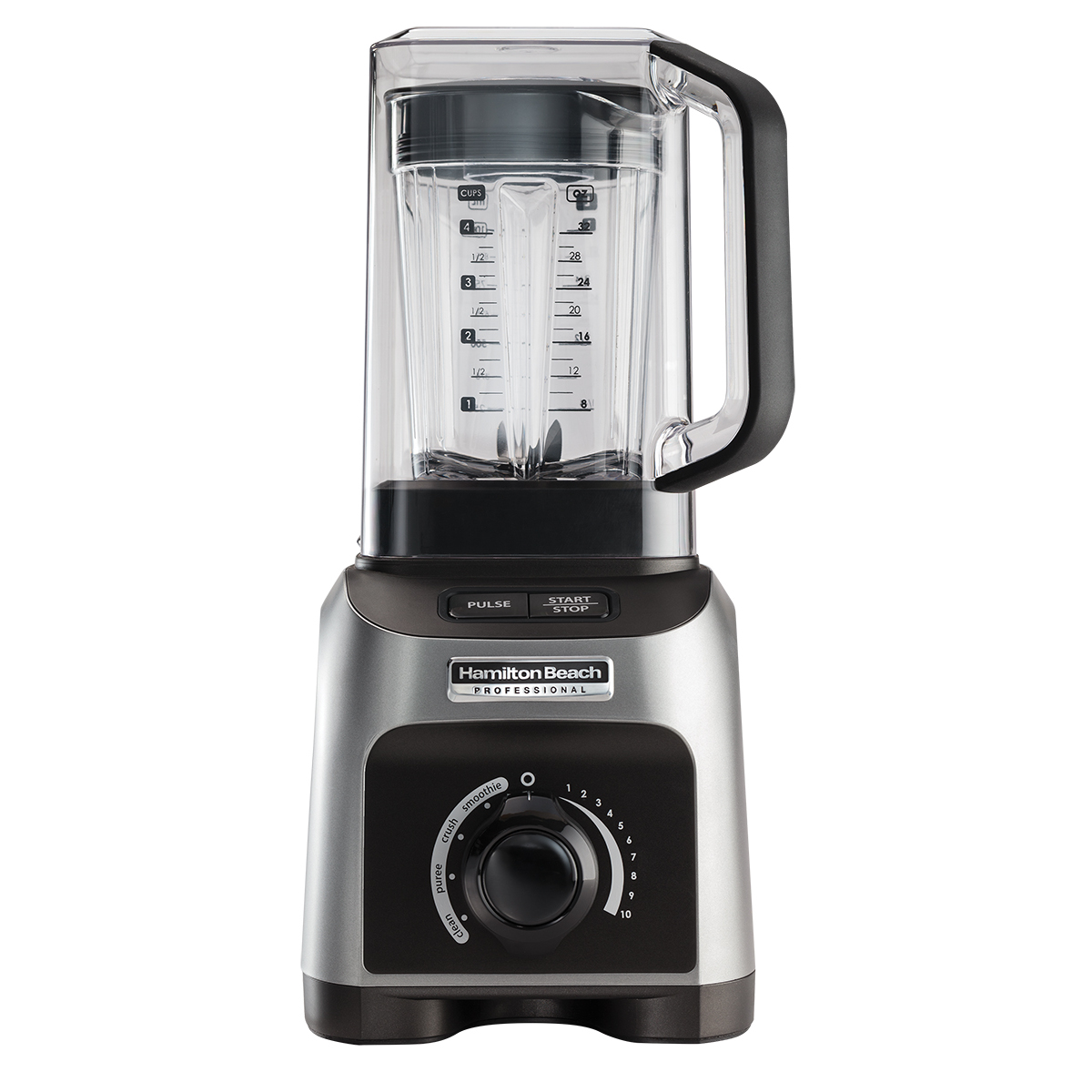
The Hamilton Beach Professional Quiet Blender 58870 is a corded countertop blender whose defining feature is a removable sound shield around a 32-ounce plastic jar. Its useful distinction is not a claim of laboratory-verified quietness: the maker gives no decibel figure. It is the combination of that enclosure, ten manually selected speeds, a separate Pulse button, three food programs and a dedicated Clean setting. The small-for-a-countertop 32-ounce jar and careful hot-liquid procedure are just as important to the decision.
A sound shield is a physical tradeoff, not a noise score
The clear shield fits over the blending jar and is described by Hamilton Beach as reducing emitted noise. A manufacturer page also says it can serve as a pitcher. The owner guide calls it an optional sound-muffling part and shows it over the jar during ordinary blending. That is a practical feature if you want a barrier around the jar while blending; it does not establish how many decibels quieter the blender is than another machine, and it does not promise a whisper-quiet result. The exact page separately mentions rubber-mounted components and motor airflow as noise-reduction design choices, but there is no independent measurement here.
The shield also changes the routine: it is a separate part to set in place and remove. More importantly, the manual says not to use it with hot liquids. If you make soup in the jar, the quieter setup is not the hot-liquid setup. Buyers who want smaller counter footprint or a shield that can stay in place for every task should compare the base height and routine in their own kitchen rather than infer fit from the product photo.
Thirty-two ounces, with separate fill rules for hot and cold work
The included jar is labeled 32 ounces (four cups) and its graduations run to that mark. This is a medium-size batch vessel, not a 48- or 64-ounce family pitcher. The 32-ounce label is not a blanket hot-liquid allowance. In the manual’s hot-liquid steps, the maker sets a two-cup (16-ounce) maximum, instructs you to remove the shield and filler cap, start at the lowest speed, and take precautions against hot liquid forcing the lid upward. A general safeguard elsewhere in the booklet states a three-cup limit; because the step-by-step hot-liquid procedure is more restrictive, treat the lower two-cup limit as the usable ceiling and follow the manual’s full precautions. The tamper is not for hot liquids, and the separate optional personal jar is expressly not for hot ingredients.
For regular recipes, the guide says not to fill past the jar’s highest graduation, and suggests at least one cup of liquid per recipe for best performance. That one-cup suggestion is not a manufacturer-validated minimum for every recipe; dense mixtures may need more liquid or the tamper. When using the tamper, the jar should be no more than two-thirds full. These details matter more than treating the nominal capacity as an amount you can safely blend for every ingredient.
Manual control plus four named settings
The central dial selects variable speeds 1 through 10 as well as Smoothie, Crush, Puree and Clean. Start/Stop works with any setting, and the Pulse button can be used with a variable speed. The three food programs have different patterns and durations: Smoothie pulses at the start and then runs at speed 10 for a minute; Crush pulses across speeds 1–5 for a minute; Puree ramps from 1 to 10 for one minute and fifteen seconds. They stop automatically, but the manual says some recipes need more or less time. Clean is the fourth named program, not a fourth food recipe.
This gives more direct control than a small personal blender with only one-touch blending, while keeping named cycles for routine drinks and purees. It is not a food processor: chopping claims on the product page do not add an included processor bowl. Hamilton Beach markets nut-butter blending with the tamper, but this review does not infer a separate dry-grinding permission from that paste-making claim.
Cleaning, warranty and the power labels
The manufacturer lists the jar, lid and tamper as dishwasher-safe. The manual warns against the dishwasher’s Sani setting, and the base must be wiped rather than immersed. The Clean cycle is convenient, but the booklet describes different detergent amounts in its program and post-blending cleaning sections; use the current instructions supplied with the machine rather than treating either recipe as a performance guarantee. The five-year limited warranty applies to U.S. and Canadian household use, with proof of purchase and exclusions. It is a stronger stated term than the one-year coverage common on some compact personal models, but the restrictions are part of the offer.
Read the wattage language carefully. The current product listing calls the motor 1,500 watts peak / 2 peak horsepower, while the exact 58870 guide’s Mexican rating-label section lists 120 volts, 60 Hz and 600 watts. The guide explains that an input rating after 30 seconds and momentary peak power are different measures. These are manufacturer labels, not independent measurements; neither figure predicts a particular smoothie texture or proves that this model outperforms another.
Who should choose it—and who should keep looking
Consider the 58870 if a removable enclosure, manual speed choice, Pulse and an automatic Clean setting all matter, and one 32-ounce jar is enough for your typical batch. The sound shield is a feature to compare, not a promise of silence. If the household needs 48 ounces or more in one blending vessel, this jar is too small for that requirement; compare a larger-pitcher setup such as the Breville Fresh & Furious instead. If hot soup is a priority, read the 58870’s two-cup procedure before deciding whether that limit works. Manufacturer ordering is also restricted for Colorado, Maine and Minnesota on the checked page, so verify the exact model and current seller terms for your location. No outside retailer’s inventory is assumed here.
