
Your needs, this model
Does it fit your priorities?
Do you want the standard-accessory nutribullet SmartSense NBF50600 in Gunmetal Gray?
The selected page identifies NBF50600 as the standard pitcher package. The separate Combo + Additional Accessories selection is a different package and is not assumed here.
Explore this need in the finder →Would one 64-ounce labeled pitcher with a separate 56-ounce liquid MAX line meet your batch?
The product page calls it a 64-ounce pitcher, but the guide marks a lower 56-ounce LIQUID MAX and an upper 64-ounce solid MAX. The guide does not publish a minimum batch size.
Explore this need in the finder →Do you want five manual speeds, an ingredient-sensing AUTO cycle and separate manual Pulse?
The guide documents five speeds, AUTO that selects time/speed/setting, a manual BLEND start/stop button and Pulse that can be tapped or held. No fixed AUTO duration is stated.
Explore this need in the finder →Do you require hot mixtures to be permitted in the included pitcher?
The manual permits hot, warm or carbonated ingredients only in the vented pitcher. It does not state a separate hot-liquid ounce allowance, so a numerical hot-volume need remains unknown.
Explore this need in the finder →Do you require the blender to crush ice, rather than merely blend frozen ingredients with liquid?
No. The linked guide explicitly says not to crush ice. The maker describes AUTO for fresh or frozen ingredients, but that does not override the ice-crushing prohibition.
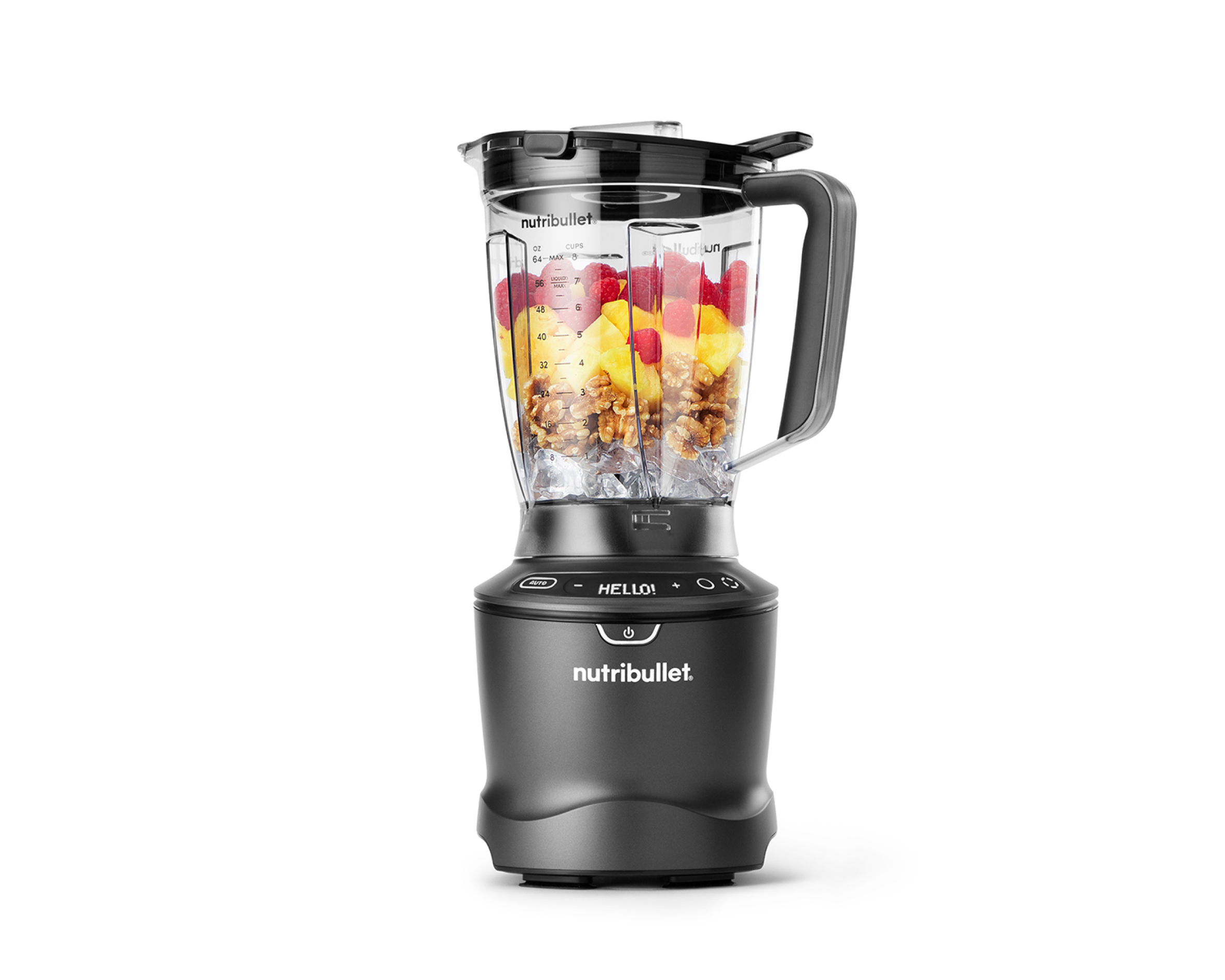
Explore this need in the finder →The nutribullet SmartSense 5-Speed Blender is a full-size countertop pitcher model, not a personal cup blender. This review is for the U.S. standard-accessory NBF50600 page selected in Gunmetal Gray. The exact page separates that version from a SmartSense Combo with additional accessories; the Combo should be judged from its own package list rather than borrowed into this one. The standard page lists a 1400-watt base, one pitcher, a lid, tamper, recipe book and guide. It does not list a blend-and-go cup. The 1400-watt figure is the maker’s rating, not a measured result or proof of a particular texture.
One pitcher, but two different marks
The manufacturer calls the included vessel a 64-ounce pitcher, and the owner guide explains why that label is not an all-purpose fill instruction. It marks a lower 56-ounce LIQUID MAX and an upper 64-ounce solid MAX. For a liquid recipe, the useful comparison is the 56-ounce line. A purchaser who only wants to know whether the jar is advertised at 64 ounces can answer yes; a cook who needs at least 64 ounces of pourable liquid should not read the label that way. The guide does not publish a recommended minimum batch, so this configuration cannot satisfy a strict small-batch threshold just because a 64-ounce pitcher seems large.
The same distinction matters for soup. The guide permits hot, warm or carbonated ingredients only in the pitcher with its vented lid and cap in place. It warns about escaping steam and splatter and says to obey the marks. However, the reviewed sources do not give a separate hot-liquid ounce allowance. The 56-ounce general liquid line therefore is not evidence that a 56-ounce hot batch is safe. If you regularly blend hot mixtures, follow the lid and steam precautions and use a smaller amount unless the manufacturer supplies a more specific limit.
Five speeds are separate from the Smart Auto choice
The distinctive control combination is a load-sensing AUTO routine alongside manual control. The guide says AUTO selects the time, speed and setting; the speed buttons provide five levels, BLEND starts or stops a manual run, and the separate Pulse button can be tapped briefly or held for a longer burst. The display counts elapsed time upward. That makes the machine more flexible than a single preset-only personal blender: start hands-on, adjust a speed, or ask the automatic cycle to choose its run. It is also different from a fixed 30- or 60-second timer. No predetermined AUTO duration is published, and the cycle is not a menu of named smoothie, soup and frozen-dessert programs.
Those controls change what you do, not a guaranteed outcome. The page recommends manual speed and Pulse for chunky textures, while AUTO is designed to aim for a smooth result. The maker says to blend fresh or frozen ingredients, to cover solids with enough liquid, and to thaw ingredients that are frozen solid for five to ten minutes. Hard or fibrous ingredients may take another cycle according to the FAQ. These are instructions and suggestions, not independent texture tests. The manual advises starting at LOW and increasing only after ingredients are integrated.
Respect the manual’s ingredient limits
The guide explicitly says not to crush ice. That is more important than a staged product image containing ice or a broad marketing description of frozen drinks. Frozen fruit used with suitable liquid is not the same as running ice alone, but this is not a machine I would choose for a dedicated ice-crushing task. The web page mentions flour-making, while the owner guide warns against dry grinding grains, cereal or coffee because it can overheat the motor or damage the blades. With that conflict between a promotional example and a specific operating restriction, do not buy this package to grind coffee or dry grains.
Cleanup is straightforward only if you separate the pieces. The pitcher is dishwasher-safe, but the guide rules out the dishwasher heat or sanitize cycle because high heat can warp the plastic. The tamper is hand-washed. The motor base must not be submerged; wipe it with a damp cloth or sponge. The instructions also warn against running the empty pitcher and call for checking damaged parts and keeping the vents unobstructed. The exact guide does not identify a named pitcher resin, so appearance alone is not a material specification.
Who should choose it—and what changes the answer?
Choose this NBF50600 if you want a substantial pitcher and value both manual speed changes and an automatic ingredient-sensing cycle. It makes less sense if your essential batch is more than 56 ounces of liquid, if you want a personal cup in the box, or if ice crushing or dry coffee grinding is non-negotiable. A warranty card and guide state one year of limited coverage from delivery; shipping or processing charges and other exclusions can apply.
The closest same-brand comparison is the Power Core XL: its reviewed package has a 72-ounce pitcher with a 64-ounce liquid mark and three manual speeds, a timed Smoothie control and held Pulse. SmartSense trades some labeled pitcher volume for five manual speeds and a sensing AUTO cycle; both manuals limit hot use to a vented pitcher and say not to crush ice or dry-grind common grains, cereal or coffee. Neither reviewed standard package includes a personal cup. If you prefer one serving blended in its drinking vessel, compare a personal model’s exact included cups and fill mark instead of assuming this pitcher package includes one. The SmartSense and Power Core comparison lays out the practical line and control differences.
Key details at a glance
| Manufacturer-listed container capacity | 64 oz |
|---|---|
| Included container style | One included 64-ounce pitcher. The guide marks a lower 56-ounce LIQUID MAX and upper 64-ounce solid MAX; do not use the 64-ounce pitcher label as a 64-ounce liquid fill or a hot-liquid allowance. |
| Documented variable-speed settings | 5 |
| Speed and Pulse controls | Five manually adjustable speeds (page FAQ lists 5,000, 7,000, 9,000, 11,000 and 21,000 RPM). AUTO selects time/speed/setting based on ingredient load; BLEND starts/stops manual speeds; PULSE supports quick taps or held runs. The display timer counts up. |
| Named programs/control modes | 1 |
| Program categories | The single named AUTO control is a sensing cycle, not a smoothie-only or recipe-category preset. No fixed cycle duration is published. |
| Published machine warranty term | 1 years |
| Warranty scope and wording | Linked guide and registration card state a one-year limited warranty from delivery; shipping/processing costs and exclusions may apply. |
| Manufacturer offer condition | new |
| Published machine weight | 7.94 lb |
| Footprint and height note | Exact page labels dimensions 17.09 in L x 13.54 in W x 12.36 in H; do not convert this line into a cabinet-clearance claim without measuring the assembled blender. |
| Manufacturer-stated motor rating | 1400 W |
| Timed cycle details | AUTO chooses a duration; the screen timer counts up. No fixed one-touch cycle length in seconds is published. |
| Manufacturer listing status when checked | Exact U.S. product page displayed Add to Cart on 2026-10-23; this is a point-in-time page observation, not a continuing stock or fulfillment guarantee. |
| Personal blending jars in package | 0 |
| Power-rating basis | The exact page and linked guide state 1400 watts. The manufacturer does not label this rating peak on the inspected page; it is not an independent electrical measurement or a texture/performance test. |
| Power source | False |
| Included personal blending cups | 0 |
| Food processor bowl included | No |
| MAX fill guidance | Linked guide labels the lower line LIQUID MAX 56 oz (7 cups) and upper solid MAX 64 oz (8 cups). The 64-ounce product-page pitcher label does not override the 56-ounce liquid line. |
| Manufacturer model / SKU | NBF50600 |
Use the exact model’s instructions for operating limits, supplied equipment and version differences.
Sources for this assessment

Choose around the way you blend.
Start with format and batch, then check manual controls, named programs, exact jar package, clearance and cleanup. In the Propel 510/750 family, a second jar is a separate setup—not extra capacity in one blend—and the Classic Bundle has a distinct hand-wash jar. In the nutribullet Ultra family, the standard NB50500IN has no processor, NB20550ID adds a separate two-cup processor, and only NB50550AKID includes the coffee/spice grinder. In nutribullet portable choices, the NBPB50100 keeps its base attached, Flex separates its base and blade, and Flip uses an insulated steel cup with a 16-ounce MAX line. Flex x McLaren’s exact page conflicts on 20 versus 22 ounces; that unknown should not meet a capacity requirement. The nutribullet Personal Blender NB50150-02 is the 700W refresh with a 21-ounce handled tumbler and a separate 24-ounce cup; use its 55-second plan and exact compatibility note rather than assuming old 600W parts fit. The current nutribullet Pro+ N12-1001MK pairs a separate 24-ounce and 32-ounce cup with a one-minute Blend cycle and manual Pulse; nominal cup labels do not replace the marked MAX line. The exact nutribullet Power Core XL Matte White NBF70100AW-02 lists a 72-ounce pitcher, 64-ounce maximum-liquid line and a maker-suggested minimum 16-ounce batch; its guide supports hot ingredients only in the vented pitcher and expressly says not to crush ice. The nutribullet Lite NBI50200 is a two-speed immersion set with a 30-ounce cup label but a 350 ml manual MAX mark; direct hot-pot blending does not specify a maximum pot or hot volume. The current McLaren Pro NB9-0901MC lists separate 32- and 24-ounce cups but showed out of stock; the discontinued Matte Eucalyptus SKU lists two separate 32-ounce cups. Oster MyBlend Plus SAP 2126144 is one cold-only sport-bottle setup; Easy-to-Clean SAP 2181510 keeps its glass pitcher and separate 20-ounce cup in different plans, and unknown cup instructions stay unknown. Oster MyBlend Plus SAP 2126144 is one cold-only sport-bottle setup; Easy-to-Clean SAP 2181510 keeps its glass pitcher and separate 20-ounce cup in different plans, and unknown cup instructions stay unknown. The Hamilton Beach Smoothie Blender 50181FG/FJ, 50182FG/FJ and 50183F/FJ family has one 48-ounce BPA-free jar, while its directly linked guide names 50180 rather than those exact codes; check the supplied manual before planning a hot batch.