
Your needs, this model
Does it fit your priorities?
Is an included food-processor bowl, rather than a pitcher alone, essential to your purchase?
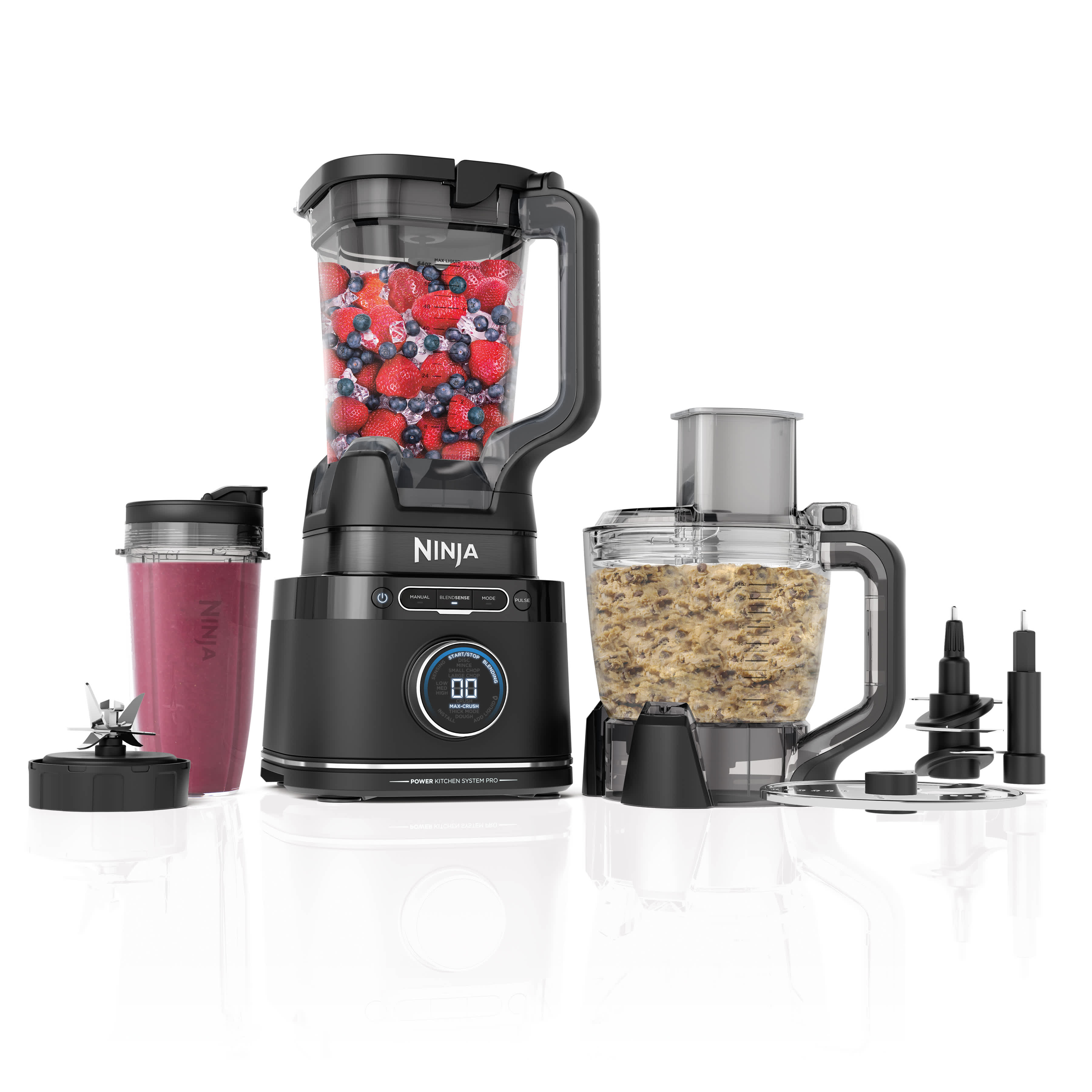
The TB401 package includes a separate eight-cup food-processor bowl, feed-chute lid and pusher, reversible disc and distinct chopping and dough blades.
Explore this need in the finder →Do you want the processor system with one 24-ounce cup, not a two-cup package?
TB401 includes one 24-ounce blending cup and spout lid alongside a separate processor bowl; TB301 includes two personal cups and no processor bowl.
Explore this need in the finder →Can you accept the exact manual’s prohibition on hot, effervescent and carbonated ingredients?
The TB401 guide expressly prohibits hot, effervescent and carbonated liquids or ingredients; it cannot satisfy an essential hot-liquid allowance.
Explore this need in the finder →The Ninja Detect TB401 combines a full-size blender, a single-serve cup and a separate food-processor bowl on one motor base. The exact US product page calls it the Detect Professional Blender and Food Processor; the owner's guide identifies the TB401 Detect Kitchen System Power Blender + Processor Pro. The shared model number resolves that naming variation. The package is for a household that will actually switch among blending, chopping, dough work and slicing or shredding—not just for someone who wants the biggest pitcher.
Three different vessels are three different jobs
The blender pitcher is listed at 72 ounces overall, and its guide sets a 64-ounce maximum liquid capacity. The package also includes one 24-ounce single-serve cup and spout lid with a Hybrid Edge blade assembly. Those parts handle individual drinks; they are not the same as the main pitcher and the cup's blade assembly must be removed after blending before the spout lid is used. Hot, effervescent and carbonated ingredients are prohibited by the manual, so neither a soup plan nor a cup plan should be inferred from the mere existence of an automatic program.
The third vessel is an eight-cup (64-ounce) food-processor bowl with a feed-chute lid and pusher. It comes with a chopping blade, a dough blade, a reversible slicing/shredding disc and spindle. Bowl capacity is not extra blender capacity: it is a separate processing vessel. The manufacturer says it can process up to two pounds of dough, a maker-stated limit rather than an independently tested result. This set can replace some separate countertop prep functions, but it also introduces a second large container, a lid with feed chute, several blades and a disc to store and clean.
Controls are not identical across the system
BlendSense is described by Ninja as automatically adjusting speed and time. The pitcher offers ten manual variable-speed settings and Pulse. The single-serve cup and processor bowl have Low, Medium and High manual speeds instead of the pitcher’s ten numbered steps. The guide describes the processor bowl's DISC, MINCE, SMALL CHOP and LARGE CHOP modes; the pitcher and processor bowl have the chop/mince modes, while DISC is for the processor bowl and reversible disc. Use the dough blade on Low only, and do not use the slicing/shredding disc with BlendSense—the manual specifically cautions against that combination. It also says not to use the processor modes with the dough blade. This is an adaptable package, not one universal control menu.
The page lists six automatic programs across the appliance system. That count does not mean six programs work in each container. The display identifies which controls are available when a vessel is installed, and the manual instructs users to remove the bowl and disc carefully. Reversible discs and loose, sharp blades need careful handling; they are not a sealed processor bowl that can be put away fully assembled with food inside.
What the extra functions cost you in routine
The pitcher and other listed accessories are top-rack dishwasher safe, but the manual warns against heated dry. Remove blade assemblies and lids before loading. The motor base should be wiped with a damp cloth, not immersed. The cup's blade head should not remain attached after blending or be used as a storage cap. The manual also prohibits dry processing and grinding in the single-serve, pitcher and processor-bowl configurations. If your primary need is grinding grains or handling hot soup, TB401 should not be selected on the basis of a high peak-watt claim or its processing attachments.
The manufacturer page lists 1,200 watts as electrical wattage and 1,800 watts as peak wattage; the guide specifies 120 volts, 60 hertz and 1,200 watts. Peak watts describe the maker's rating, not measured blending output. The same page displays a 104.72-pound weight, a value that is clearly inconsistent with the page's ordinary compact-appliance context. I do not repeat it as a usable weight specification or substitute a guessed correction. If exact counter clearance or lifting weight is decisive, check the current manufacturer support information before purchase; no dimensions or weight are used to rank the machine here. The current US offer gives a one-year limited warranty, not a reliability promise.
TB401 versus TB301 and TB201
TB401 is the only one of these three packages with the eight-cup processor bowl, feed chute, reversible slicing/shredding disc and dough blade. It includes one 24-ounce blending cup. TB301 includes two 24-ounce blending cups and their spout lids but no processor bowl, so it suits a household that wants to prepare individual drinks for more than one person. TB201 has a pitcher, BlendSense and pitcher chopping modes, but no personal cup or food-processor attachment; it is the more focused setup when large batches are the priority.
Choose TB401 if the processor will do repeated prep work and the kit can live within reach. Choose TB301 if two personal cups matter more than slicing, shredding and dough processing. Choose TB201 if those secondary operations would be unused accessories. In each case the 72-ounce pitcher's 64-ounce liquid line remains the same distinction: use the marked safe liquid maximum, not the advertised nominal size, to judge a recipe. Compare manuals before treating a food type or vessel as interchangeable across the system.
Key details at a glance
| Manufacturer-listed container capacity | 72 oz |
|---|---|
| Included container style | 72-ounce nominal pitcher; the model guide marks a 64-ounce maximum liquid line. |
| Documented variable-speed settings | 10 |
| Speed and Pulse controls | Ten numbered manual pitcher speeds and Pulse; the cup and processor bowl instead have Low, Medium and High manual speeds; BlendSense; separate processor DISC, MINCE, SMALL CHOP and LARGE CHOP modes; use the dough blade on Low only. |
| Named programs/control modes | 6 |
| Program categories | The official page gives the automatic-program count; the manual ties functions to specific vessel configurations. The count is not a performance result and controls do not all run with each vessel. |
| Published machine warranty term | 1 years |
| Warranty scope and wording | One-year limited warranty shown for the exact US product offer and model guide; no prediction of service life or coverage beyond the published limited term is made. |
| Manufacturer offer condition | new |
| Cleaning and heat guidance | Listed attachments are top-rack dishwasher safe, without heated dry. Remove the blade assembly and lids before dishwashing; wipe the motor base rather than immersing it. All detachable blades are loose and sharp and require careful handling. |
| Included jar material | BPA-free plastic; polymer subtype not stated in the inspected package documentation. |
| Manufacturer-stated motor rating | 1200 W |
| Timed cycle details | Manual speeds and automatic programs are listed; fixed 60- or 90-second recipe-cycle durations are not established. |
| Manufacturer listing status when checked | Exact US manufacturer product route showed a named model, current product detail and an order control when checked. Stock, delivery and price are not asserted. |
| Published base material / finish | The exact page calls the color Black; that finish name is not evidence of a steel base material. |
| Personal blending jars in package | 0 |
| Power-rating basis | The manufacturer lists 1,200 watts electrical input at 120 V / 60 Hz and separately promotes 1,800 peak watts. Peak watts are not independent measured blending output. |
| Largest directly blending cup label | 24 oz |
| Smaller blending cup label | 24 oz |
| All included cups are top-rack safe | Yes |
| Included personal blending cups | 1 |
| Food processor bowl included | Yes |
| Processor-bowl capacity | 8 cups |
| Manufacturer peak-watt rating | 1800 W peak |
| MAX fill guidance | The TB200-series owner-guide evidence recorded for this exact package marks the 72-ounce pitcher MAX LIQUID at 64 ounces. This pitcher line is not assigned to its separate personal cup; no cup maximum is inferred here. |
| Manufacturer model / SKU | TB401 |
Use the exact model’s instructions for operating limits, supplied equipment and version differences.
Sources for this assessment
Choose around the way you blend.
Start with format and batch, then check manual controls, named programs, exact jar package, clearance and cleanup. In the Propel 510/750 family, a second jar is a separate setup—not extra capacity in one blend—and the Classic Bundle has a distinct hand-wash jar. In the nutribullet Ultra family, the standard NB50500IN has no processor, NB20550ID adds a separate two-cup processor, and only NB50550AKID includes the coffee/spice grinder. In nutribullet portable choices, the NBPB50100 keeps its base attached, Flex separates its base and blade, and Flip uses an insulated steel cup with a 16-ounce MAX line. Flex x McLaren’s exact page conflicts on 20 versus 22 ounces; that unknown should not meet a capacity requirement. The nutribullet Personal Blender NB50150-02 is the 700W refresh with a 21-ounce handled tumbler and a separate 24-ounce cup; use its 55-second plan and exact compatibility note rather than assuming old 600W parts fit. The current nutribullet Pro+ N12-1001MK pairs a separate 24-ounce and 32-ounce cup with a one-minute Blend cycle and manual Pulse; nominal cup labels do not replace the marked MAX line. The exact nutribullet Power Core XL Matte White NBF70100AW-02 lists a 72-ounce pitcher, 64-ounce maximum-liquid line and a maker-suggested minimum 16-ounce batch; its guide supports hot ingredients only in the vented pitcher and expressly says not to crush ice. The nutribullet Lite NBI50200 is a two-speed immersion set with a 30-ounce cup label but a 350 ml manual MAX mark; direct hot-pot blending does not specify a maximum pot or hot volume. The current McLaren Pro NB9-0901MC lists separate 32- and 24-ounce cups but showed out of stock; the discontinued Matte Eucalyptus SKU lists two separate 32-ounce cups. Oster MyBlend Plus SAP 2126144 is one cold-only sport-bottle setup; Easy-to-Clean SAP 2181510 keeps its glass pitcher and separate 20-ounce cup in different plans, and unknown cup instructions stay unknown. Oster MyBlend Plus SAP 2126144 is one cold-only sport-bottle setup; Easy-to-Clean SAP 2181510 keeps its glass pitcher and separate 20-ounce cup in different plans, and unknown cup instructions stay unknown. The Hamilton Beach Smoothie Blender 50181FG/FJ, 50182FG/FJ and 50183F/FJ family has one 48-ounce BPA-free jar, while its directly linked guide names 50180 rather than those exact codes; check the supplied manual before planning a hot batch.