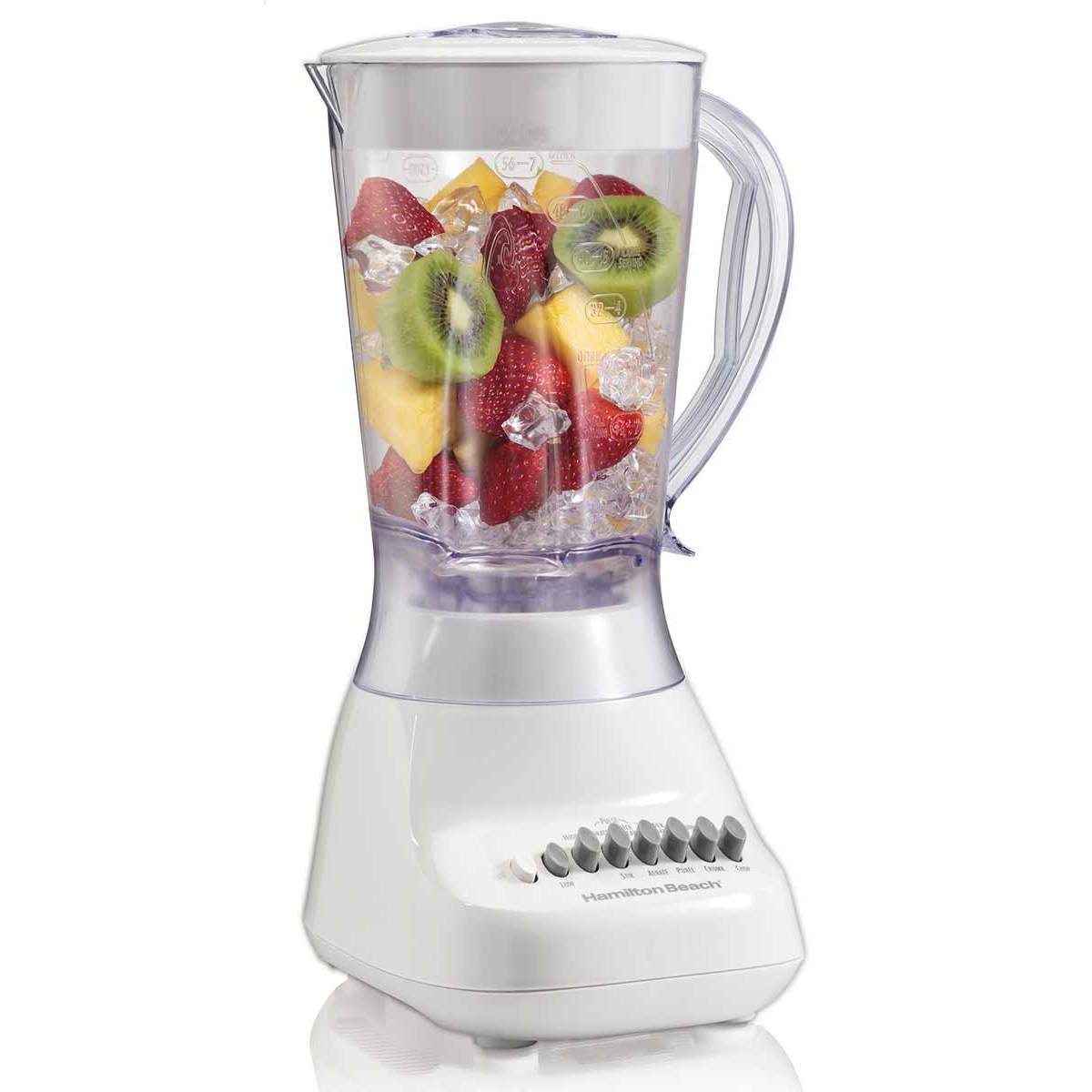
Hamilton Beach’s Smoothie 10 Speed Blender appears here as two exact U.S. codes: white 50166G and black 50167G. Their model pages describe the same 56-ounce pitcher, ten-speed setup, Wave-Action blending design, dishwasher-safe jar, 575-watt peak claim and three-year warranty. The difference is the listed finish and page-level availability, not a reason to assume different blending capabilities. Each code remains visible so you can match the item you actually find.
A larger pitcher for ordinary family-size batches
The nominal 56-ounce jar gives this set more room than a 48-ounce compact pitcher, but it still falls short of a 64-ounce minimum. Its printed capacity is not a safe fill line for every recipe. If your routine involves a large batch of smoothies, shakes or icy drinks, the larger jar is a straightforward advantage over a 48-ounce model. If you usually make one drink and want to blend directly into a cup, this is the wrong format: the exact pages list a pitcher setup, not a personal travel vessel or a processor bowl.
The maker describes the jar as dishwasher-safe and says the food zones are BPA-free. That does not identify the jar’s material, so don’t treat its clear appearance as proof that it is glass. If glass is essential, compare the exact glass-pitcher models instead; if material is flexible, focus on the volume and care instructions that are actually stated.
Ten selectable speeds, not a preset-heavy machine
The exact pages call this a ten-speed blender for smoothies, shakes and icy drinks. The linked Use & Care guide names models 50166 and 50167 and explicitly allows letter suffixes, which bridges the G codes. It describes the push-button routine: choose LO or HI, then press a speed button; speed increases from left to right. Pulse runs only while you hold its button. This is manual control, not an automatic timed smoothie program. The manual also says not to run continuously beyond three minutes.
Hamilton Beach attributes circulation to its Wave-Action system and lists 575 watts of peak power. The guide’s model table gives a 400-watt, 120-volt, 60-Hz electrical rating for the 50166/50167 group. Those are different manufacturer figures: the guide explains that the electrical rating and short-lived peak power are not interchangeable. Neither figure is an independent test of texture, speed, durability or noise.
Useful guardrails for liquid and hot recipes
The manual says a recipe needs at least one cup—8 ounces—of liquid for best performance, and advises adding more if ingredients stop moving or cling to the jar. It specifically rules out dry grains or coffee beans, raw meat, stiff dough, whipping egg whites and extracting juice. This is a blender for wet mixtures, not a substitute for a grinder, juicer or food processor.
For hot liquids, the guide’s limit is three cups, or 24 ounces, in the jar. It tells you to remove the filler cap from the two-piece lid, close pour openings, protect the lid, keep skin away and begin at the lowest speed. That 24-ounce hot limit is far below the jar’s nominal 56-ounce capacity. It is a specific procedure, not permission to fill the jar with hot soup to its rim.
Two exact finishes, with a clear alternative
Choose 50166G for the white finish or 50167G for black. The pages showed different availability when checked, so do not assume both color listings can be ordered at the same time. Their exact code and page condition matter more than an old listing title. A current 48-ounce 50192 offers ten maker-listed speeds and a smaller BPA-free jar, but its linked guide does not list 50192; it is not a drop-in substitute if the model-specific hot-use procedure matters. The 50184J steel-blue model is another 48-ounce option, but its page describes twelve functions on five buttons rather than this manual’s ten-speed panel.
Bottom line: 50166G and 50167G suit a shopper who wants a straightforward 56-ounce, ten-speed pitcher with a documented liquid minimum and a useful 24-ounce hot-liquid procedure. Skip them if you need a 64-ounce vessel, confirmed glass, a personal blending cup or dry grinding.