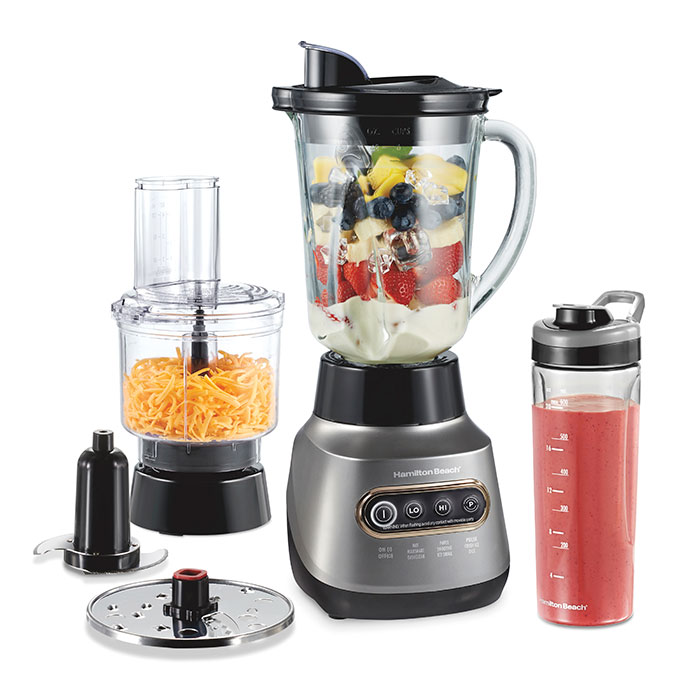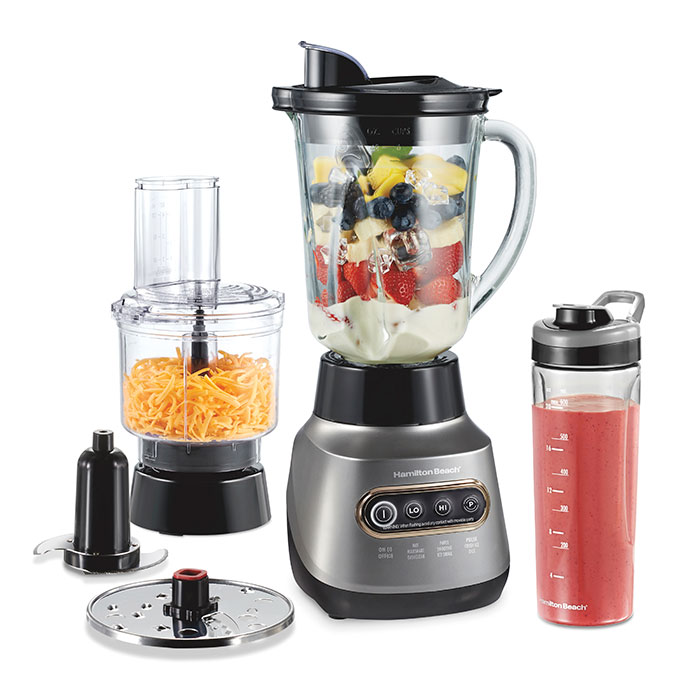
The Hamilton Beach 3-in-1 Electronic Kitchen System 53800FJ is a three-setup countertop package built around one base: a 48-ounce glass pitcher, a 20-ounce travel jar, and a separate 3-cup food-processor attachment. The differences are functional, not just extra containers. Use the pitcher for shared drinks and sauces, the personal jar for one cold drink to take away, or the small processor bowl for chopping, slicing and shredding.
Three setups, three different limits
The exact manufacturer page lists a 48-ounce glass blending jar, a 20-ounce personal travel jar with drinking lid, and a 3-cup food-processor attachment. The processor package includes a chopping/mixing blade and a reversible slicing/shredding disc, with a chute and pusher. Swap these vessels and adapters on the same corded base; the capacities are not additive, and the processor bowl is not another blender pitcher. This distinction makes the model more versatile than a jar-only blender but keeps the processor side intentionally small: the guide's task chart limits common chopping, mixing and puree loads to two cups, or five ounces for grated cheese, and requires staying below the bowl's fill marks.
The maker advertises 800 watts of peak power and nine functions. The model-specific guide identifies model 53800FJ, type B103, and lists 120 volts, 60 hertz and 3.2 amps; those electrical details should not be converted into a competing performance score. The page also promotes its Wave~Action system and quieter design. Those are manufacturer descriptions, not measured texture or sound results. The control pad gives speed buttons and named options including Puree/Smoothie/Icy Drink, Slice/Shred/Milkshake/EasyClean, Low, High and Pulse; Pulse operates only while held. Treat “nine functions” as the page's control claim, not proof that nine fully automatic timed recipes are present. The manual caps operating time at three minutes for any attachment or speed setting.
Pitcher blending and hot-food handling
For ordinary cold batches, the 48-ounce pitcher meets the finder’s medium floor but not a 64-ounce minimum. The guide says to add at least eight ounces of liquid first and not to fill ingredients above its 48-ounce line. That minimum-liquid advice is useful if you usually make small batches: a wide nominal capacity does not imply that a few spoonfuls of thick ingredients will circulate. For frozen drinks, the guide gives a recipe using ten ice cubes and directs the user to the Icy Drink program or a Pulse-and-High sequence; it does not establish an ice-only load or a measured smoothness guarantee.
The guide permits hot ingredients in the main pitcher with specific precautions: open the center vent, close the edge cover used for pouring, hold the lid with an oven mitt or thick towel, start at the lowest speed and do not exceed the 48-ounce fill line. That is different from permission for the travel jar: the manual says not to blend hot liquids there. It also gives a 20-ounce nominal travel jar with a MAX line but does not state the line's numerical volume. For that jar it recommends at least six ounces of liquid per recipe, putting frozen ingredients at the blade end before turning the jar over, and stopping to shake if ingredients stick. A 20-ounce label is not a numeric usable-fill promise.
The processor is a small prep station, not a full-size food processor
The bowl can chop, mix, puree, slice and shred with the included attachments, but the manual sets boundaries that should guide the decision. Use the food pusher rather than fingers in the chute; the disc is sharp and must be installed with its Slice or Shred label facing up. The maker excludes ice crushing, grinding grain, coffee or spices, frozen-meat slicing and dough kneading. It also warns that starchy vegetables can turn gummy if overprocessed, says to let the attachment rest about four minutes after extended continuous operation, and lists a maximum three-minute operating period for any accessory or speed setting.
Cleaning is not quite a single rinse-and-go routine. The glass pitcher and most removable components are dishwasher-safe, but the food-processor adapter and red adapter are not; the guide says to wipe those by hand and avoid the dishwasher's Sanitize cycle. EasyClean is a pitcher rinse routine, not a substitute for taking parts apart and thoroughly washing them after processing a food. Keep the base and cord dry, and take care around both the blender blade assembly and processor tools.
Who should choose the 53800FJ?
It is a sensible configuration to consider if you want a glass jar, one travel cup and a processor bowl that can perform small slicing and shredding jobs from one base. It fits a 48-ounce batch floor, a three-cup processor minimum, and a glass-only requirement; it does not fit a 64-ounce pitcher minimum or a four-cup processor requirement. The 20-ounce cup and 48-ounce pitcher are separate setups, so the cup does not increase batch size. Choose the Hamilton Beach Stay or Go 52400 if two travel cups and a smaller dry-grinding cup matter more than glass and processor functions; choose the MultiBlend 53520J if you prefer its 48-ounce Tritan pitcher plus processor bowl and do not need a personal jar. These are different package choices, not evidence that one has better measured blending performance.
In the finder, the exact 53800FJ package selector is optional confirmation. A preference for a processor bowl can also be tested independently: the separate bowl and three-cup size are documented, but the dicing-kit requirement should remain unmet because no dicing kit is listed. If hot blending matters, use the exact manual's pitcher setup and 48-ounce instruction rather than transferring permission to the travel cup or processor bowl. For a retail search, use “Hamilton Beach 53800FJ 3-in-1 Electronic Kitchen System” and verify all three components are in the offer; a family name or image alone is not a package list.
Manufacturer references: Hamilton Beach 53800FJ product page and its linked Use & Care Guide 840377200.