
Your needs, this model
Does it fit your priorities?
Do you specifically want the earlier Cuisinart Supreme Super 600 SB-5600, not just a similarly named six-speed blender?
The exact U.S. page ties model SB-5600 to a Brushed Stainless finish, 60-ounce glass jar, 600-watt listing and discontinued/out-of-stock state.
Explore this need in the finder →Does the SB-5600’s nominal 60-ounce glass jar fit your usual batch, or must the jar be at least 64 ounces?
The exact jar is 60 ounces, enough for the finder’s 48-ounce medium floor but below 64 ounces; no safe finished-fill line is published.
Explore this need in the finder →Do you want manual push-button speeds plus Pulse and a dedicated pulsed Ice Crush control, without a timed drink program?
The exact booklet documents Cuisinart’s six-speed push-button description, manual speed selection, Pulse and Ice Crush in short bursts; no timed recipe cycle is documented.
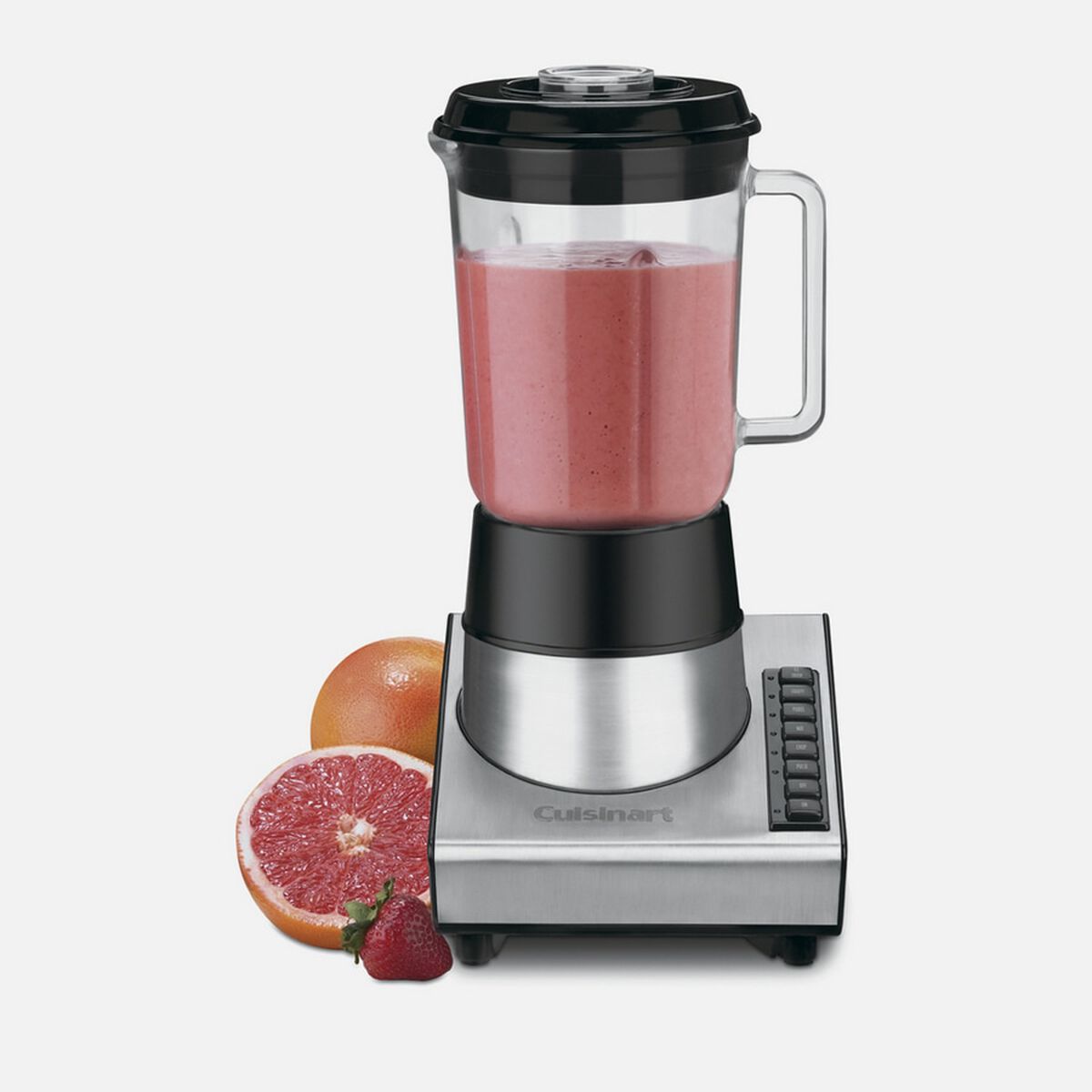
Explore this need in the finder →The Cuisinart Supreme Super 600 SB-5600 is an earlier full-size blender built around one nominal 60-ounce heavy glass jar. Cuisinart’s exact U.S. listing names the model SB-5600, a Brushed Stainless finish, a 600-watt high-torque motor and a 2-ounce measured pour lid; the listing marks it discontinued and out of stock. This review is useful for comparing an identified used machine or understanding the product family, not as evidence of new retail stock.
More jar than a small countertop unit, not a 64-ounce pitcher
The 60-ounce jar clears a 48-ounce minimum but not a strict 64-ounce family requirement. That number describes nominal jar capacity, not the safe finished volume for a foamy drink or hot mixture. The exact product page and booklet do not establish a numeric maximum-liquid or finished-batch line, so do not treat 60 ounces as a fill-to-the-rim recipe allowance. The jar is glass, with a widemouth opening, pour spout, lid and measured pour cap. Glass avoids a plastic pitcher, but it adds weight and requires care: the manual warns not to use a chipped or cracked jar and describes thermal-shock cautions around hot dishwashing and cold contents.
The included setup is a countertop jar, not a family of alternate containers. The exact page lists no personal cup or processor bowl. That makes the SB-5600 simpler to compare with the single-jar CB-9 and CBT-700 than with Cuisinart’s SmartPower Duet packages. If your must-have is a separate processor, the BFP-703 offers a different configuration, but its 40-ounce blender jar and three-cup processor bowl are separate setups, not added capacity.
Six-speed buttons do not mean six timed cycles
Cuisinart markets the controls as preprogrammed six-speed push buttons with LED indicators. Its booklet explains the speed buttons for Chop, Mix, Purée and Liquefy, then describes Pulse at any speed and a separate Ice Crush control. The manufacturer's six-speed language is the product’s control description, not a set of six timed recipes: the instructions show the user selecting a speed, changing it manually and stopping it. No timed smoothie or cleaning cycle is documented. Ice Crush itself operates in short pulses, so choose it for controlled bursts rather than expecting a hands-off countdown.
This is different from the CBT-700, whose booklet documents timed Smoothie and Ice Crush routines alongside Low/High/Pulse. The SB-5600 has a larger jar than that 56-ounce model and a 600-watt rating, but the rating is a maker specification, not a comparison test. The manual describes cyclonic blending action as Cuisinart’s design claim; it does not provide independent texture, durability or noise measurements. If choosing between these older machines, decide whether nominal 60-ounce glass capacity and several named manual speeds matter more than a smaller jar with timed routines. Neither choice establishes performance superiority.
Ice has a specific short-burst use
The booklet says the motor can crush ice without liquid and directs the user to activate Ice Crush in short pulses. Its recipe tips provide a concrete example of up to 10 standard ice cubes in the jar, pulsed until snow-like or coarser as desired. That is a documented ice plan; it is not permission for unrestricted frozen solids. The manual says not to add solid frozen foods except ice cubes or ½-inch frozen-fruit pieces. It also cautions against thermal shock, including loading very cold contents into a jar just removed from a hot dishwasher.
For hot work, remove the measured center lid to let steam escape. Boiling liquids should cool for five minutes before being added. Neither the exact page nor the manual gives a maximum hot-liquid amount, so a shopper who needs a published hot-fill capacity should treat this as unknown rather than infer one from the 60-ounce nominal jar. Keep the cover on during blending and follow the manual’s assembly sequence; the blade assembly, gasket and locking ring fit at the jar base, so it is important to inspect and correctly tighten the ring.
Separate parts add cleaning and used-unit checks
The glass jar may be placed upside down in the dishwasher. The cover and measured pour lid can go on the upper rack, and the locking ring is also listed for the upper rack. The blade assembly and gasket are removed and washed by hand; the sharp blade should not be disassembled. The base is wiped with a damp cloth and must not go in the dishwasher or be submerged. That routine is practical if the removable parts are kept complete, but it involves more disassembly than a single-serve vessel with an integrated blade base.
Cuisinart lists a limited three-year warranty for the original product. That term cannot establish remaining coverage or transfer on a used example. For a secondhand listing, check the model plate, glass for chips or cracks, locking ring, gasket, blade assembly, lid and measured cap, and confirm the motor base stops and starts as described before relying on it. The exact manufacturer page also lists a jar sealing gasket as a part; seeing a replacement part on that page does not mean the used package includes one.
Who should look for SB-5600?
Consider it as an earlier reference if you want a larger, nominal 60-ounce glass jar, a 600-watt manufacturer rating, manual push-button speed selection, Pulse and a dedicated pulsed ice control. It does not suit a 64-ounce minimum, a confirmed 60-ounce safe fill, a timed recipe-menu requirement or a shopper seeking a currently stocked new machine. The 40-ounce CB-9 is smaller and has a five-speed touchpad identity; the 56-ounce CBT-700 documents timed smoothie and ice routines; the 40-ounce BFP-703 adds a separate three-cup processor but not a larger blender jar. Those comparisons help determine what setup fits your tasks without turning discontinued listings into current purchase recommendations.
Manufacturer sources: Cuisinart SB-5600 product page and its SB-5600 instruction booklet.
Key details at a glance
| Manufacturer-listed container capacity | 60 oz |
|---|---|
| Included container style | One nominal 60-ounce glass jar with lid and 2-ounce measured pour lid; no numeric safe finished-fill or hot-liquid maximum is published. |
| Documented variable-speed settings | 6 |
| Speed and Pulse controls | Cuisinart names six-speed push-button controls. The booklet lists Chop, Mix, Purée and Liquefy speed keys, Pulse at any speed and separate Ice Crush. Ice Crush uses short pulses; the six-speed label is not a timed recipe program. |
| Named programs/control modes | 0 |
| Published machine warranty term | 3 years |
| Warranty scope and wording | The original manufacturer booklet lists a limited three-year term. It does not establish remaining eligibility, transferability, or serviceability of a used/discontinued unit. |
| Footprint and height note | No exact dimensions or assembled clearance found in the inspected manufacturer product page or manual. |
| Cleaning and heat guidance | Jar can be placed upside down in dishwasher. Cover and measured cap are upper-rack items; locking ring is also listed for the upper rack. Cutting assembly and gasket are hand-washed after unplugging and disassembly. Base is wiped with a damp cloth only, never immersed or dishwashed. |
| Included jar material | Glass |
| Included jar / additional blending setup | One nominal 60-ounce glass jar on one countertop blending setup; no additional blending container or separate processor is documented for this exact package. |
| Manufacturer-stated motor rating | 600 W |
| Timed cycle details | No timed recipe program or one-touch countdown is documented in the exact product page/manual. Named speed controls and pulsed Ice Crush are not counted as timed recipe cycles. |
| Manufacturer listing status when checked | The exact Cuisinart U.S. page displayed Discontinued and Out Of Stock on 2026-10-24; current third-party inventory, used condition and transfer of warranty are not established. |
| Personal blending jars in package | 0 |
| Power-rating basis | Cuisinart lists a 600-watt high-torque motor; this maker rating is not an independent performance measurement. |
| Power source | False |
| Included personal blending cups | 0 |
| Food processor bowl included | No |
| Blending blade dishwasher-safe | No |
| MAX fill guidance | Nominal jar capacity is not a promised finished batch or safe hot-fill amount; no corresponding numeric limit is published in the exact page/manual. |
| Manufacturer model / SKU | SB-5600 |
| Reversible processor slicing/shredding disc included | False |
Use the exact model’s instructions for operating limits, supplied equipment and version differences.
Sources for this assessment
Choose around the way you blend.
Start with format and batch, then check manual controls, named programs, exact jar package, clearance and cleanup. In the Propel 510/750 family, a second jar is a separate setup—not extra capacity in one blend—and the Classic Bundle has a distinct hand-wash jar. In the nutribullet Ultra family, the standard NB50500IN has no processor, NB20550ID adds a separate two-cup processor, and only NB50550AKID includes the coffee/spice grinder. In nutribullet portable choices, the NBPB50100 keeps its base attached, Flex separates its base and blade, and Flip uses an insulated steel cup with a 16-ounce MAX line. Flex x McLaren’s exact page conflicts on 20 versus 22 ounces; that unknown should not meet a capacity requirement. The nutribullet Personal Blender NB50150-02 is the 700W refresh with a 21-ounce handled tumbler and a separate 24-ounce cup; use its 55-second plan and exact compatibility note rather than assuming old 600W parts fit. The current nutribullet Pro+ N12-1001MK pairs a separate 24-ounce and 32-ounce cup with a one-minute Blend cycle and manual Pulse; nominal cup labels do not replace the marked MAX line. The exact nutribullet Power Core XL Matte White NBF70100AW-02 lists a 72-ounce pitcher, 64-ounce maximum-liquid line and a maker-suggested minimum 16-ounce batch; its guide supports hot ingredients only in the vented pitcher and expressly says not to crush ice. The nutribullet Lite NBI50200 is a two-speed immersion set with a 30-ounce cup label but a 350 ml manual MAX mark; direct hot-pot blending does not specify a maximum pot or hot volume. The current McLaren Pro NB9-0901MC lists separate 32- and 24-ounce cups but showed out of stock; the discontinued Matte Eucalyptus SKU lists two separate 32-ounce cups. Oster MyBlend Plus SAP 2126144 is one cold-only sport-bottle setup; Easy-to-Clean SAP 2181510 keeps its glass pitcher and separate 20-ounce cup in different plans, and unknown cup instructions stay unknown. Oster MyBlend Plus SAP 2126144 is one cold-only sport-bottle setup; Easy-to-Clean SAP 2181510 keeps its glass pitcher and separate 20-ounce cup in different plans, and unknown cup instructions stay unknown. The Hamilton Beach Smoothie Blender 50181FG/FJ, 50182FG/FJ and 50183F/FJ family has one 48-ounce BPA-free jar, while its directly linked guide names 50180 rather than those exact codes; check the supplied manual before planning a hot batch.