
Your needs, this model
Does it fit your priorities?
Do you specifically want the discontinued Cuisinart CBT-500FP SmartPower Premier Duet package?
The exact U.S. listing identifies the Stainless Steel CBT-500FP with a 50-ounce glass pitcher and a separate three-cup processor setup, but marks it discontinued and out of stock.
Explore this need in the finder →Is a compact three-cup processor bowl with a feed tube and reversible slicing/shredding disc useful for your prep?
The exact package lists a three-cup bowl, chopping blade and reversible disc. Its bowl is a separate, smaller processor vessel, not extra blender-jar capacity.
Explore this need in the finder →Would a 50-ounce glass pitcher and manual Low/High/Pulse/Ice Crush controls fit your blending routine?
The manufacturer lists one nominal 50-ounce glass jar. Its Low/High/Pulse/Ice Crush pad and count-up timer are not automatic smoothie presets, and the jar has no published numeric hot-fill allowance.
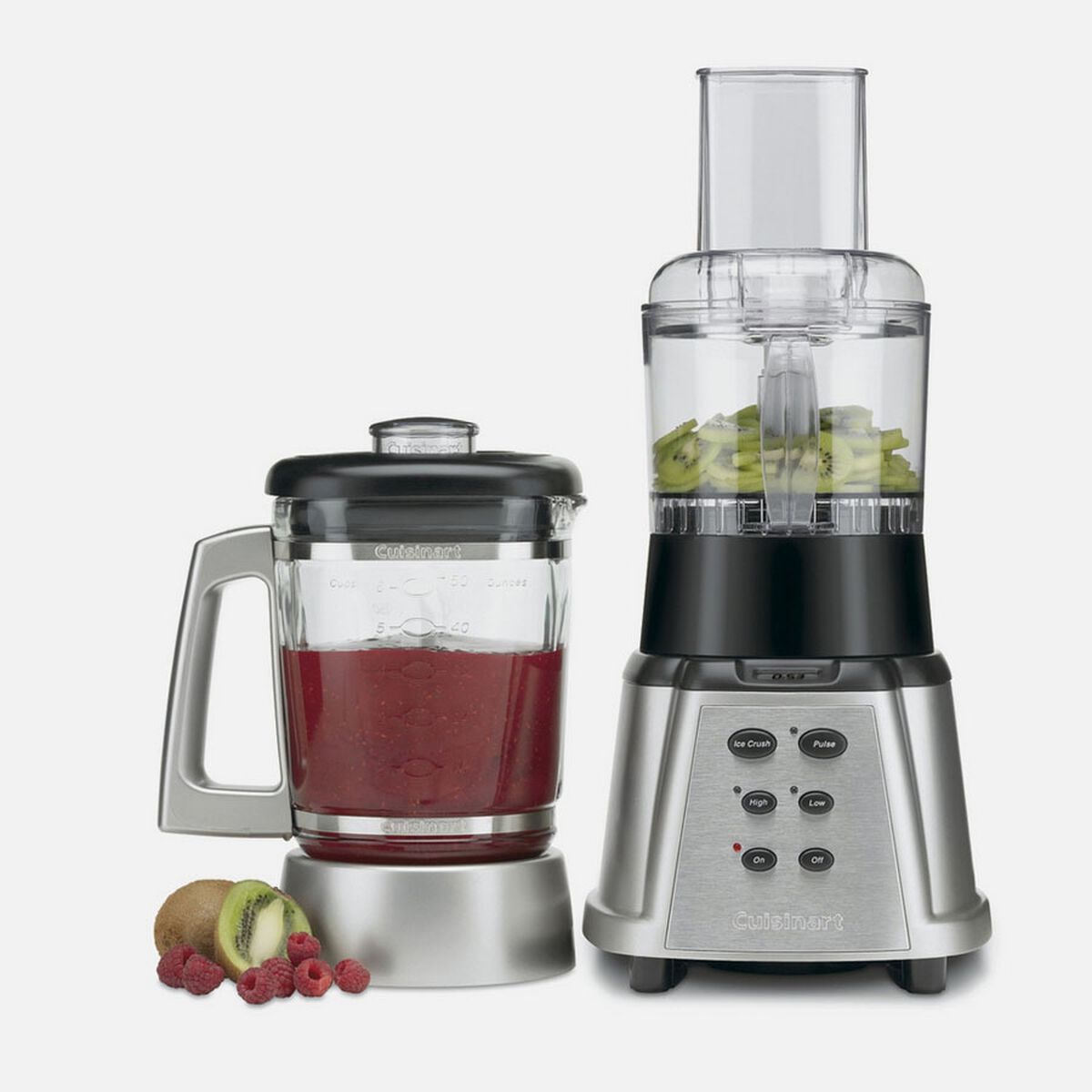
Explore this need in the finder →The discontinued Cuisinart SmartPower Premier Duet CBT-500FP is not just a 50-ounce blender pitcher with a few extra accessories in the box. Its distinguishing feature is a second, separate food-processing setup that uses the same motor base: you can install the glass jar for blending, or change to a three-cup work bowl with a chopping blade and reversible slicing/shredding disc. Cuisinart’s exact U.S. listing identifies the Stainless Steel finish and marks the model discontinued and out of stock, so it is best treated as an earlier-model reference or a used-unit possibility—not a promise of new stock.
Two different vessels, two different jobs
The jar side is a nominal 50-ounce glass blender vessel with a fitted lid and removable measured pour cap. That is a useful size class for drinks, sauces and the recipes in the booklet, but the listing does not give a safe finished-fill or hot-liquid maximum. A 50-ounce jar label is therefore not the same as a 50-ounce batch recommendation. The manufacturer describes a wide mouth, which can help with loading and cleaning access, but no independent texture or speed test is claimed here.
For the other setup, remove the jar and install the processor bowl on its gearbox collar. The official product page lists a three-cup bowl, feed tube, chopping blade and slicing/shredding disc; the linked booklet also describes a pusher and adapter stem. Three cups is a compact prep capacity, not a full-size food processor. It can make sense for small batches of chopped ingredients, dips or a quick slice/shred job, but anyone preparing large quantities should compare a dedicated processor with a larger work bowl. The jar and work bowl are used one at a time: their capacities do not add together, and the machine cannot blend and process simultaneously.
What the controls actually offer
The blender controls are straightforward push buttons: On and Off, Low and High, Pulse and a dedicated Ice Crush function. The five-minute Count-Up timer measures elapsed run time; it does not select a recipe or promise the right texture for a particular drink. Cuisinart says the controls beep continuously after five minutes of blending. The instruction book explains how the display counts up and resets, but neither page presents independent speed or performance measurements.
For ice, the booklet describes the Ice Crush control as a pulsing routine and also says the motor can crush ice without liquid. It does not set a numerical ice-only load limit. Follow the short-burst instructions instead of treating the ice button as a guaranteed finished-drink cycle. The manual also warns against loading other solid frozen food into the jar except the specific small frozen-fruit pieces it names. The food-processor setup follows different High and Pulse instructions; do not assume a blender-jar Ice Crush capability applies to the small work bowl.
Glass, hot ingredients and cleanup
Glass is a practical choice if you prefer not to use a plastic pitcher, but it is still a breakable vessel. The manual says not to use a chipped or cracked jar and cautions against thermal shock. For hot blending, remove the measured pour cap to let steam escape and let boiling ingredients cool for five minutes first. The booklet gives no numeric hot-fill capacity, so this is not a documented 50-ounce soup blender. If you require a confirmed hot-liquid volume, this model cannot meet that threshold from the evidence available.
Care differs by tool. The jar may be placed upside down in the dishwasher; its lid and measured cap can go on the upper rack. The blender blade assembly and gasket are removed and washed by hand. The processor bowl, cover, pusher, chopping blade and disc are listed as top-rack dishwasher-safe, but its gearbox collar is not immersible and must be wiped with a damp cloth. That extra assembly and its sharp attachments are the trade for having a small processor function on the same base.
Who should consider it—and what to compare
The CBT-500FP suits someone who values two modest-capacity tools sharing one countertop base, wants a glass 50-ounce blender jar and expects occasional small-batch chopping or slicing. It is less suitable if you need a large processor bowl, a single combined vessel, automatic smoothie programs, a confirmed hot fill, or current factory stock. It has no named recipe cycles; the timed display is elapsed time, not automation.
Compared with the standalone CBT-500, the CBT-500FP adds the three-cup food-processor attachment to a similarly described SmartPower Premier 600-watt blender platform. Check exact SKU and all attachments on a used listing rather than assuming a CBT-500 base includes the Duet tools. Compared with the newer-discontinued CBT-600GRY, the CBT-500FP uses a nominal 50-ounce glass jar and adds a processor setup; the CBT-600GRY is a smaller 48-ounce Tritan pitcher with a manual rotary control. The CBT-1500P1 is a still larger 60-ounce Tritan model with two timed routines, while the SPB-8 uses a 48-ounce Tritan pitcher and dedicated touchpad Ice Crush cycle. All are earlier/out-of-stock references, not current-stock recommendations.
For a secondhand CBT-500FP, confirm the model plate, intact glass jar, lid and cap, blade block and gasket, processor bowl and collar, pusher, adapter stem and reversible disc. A Cuisinart page lists a limited three-year original warranty, but that does not establish remaining coverage or transferability. The exact manufacturer product page and its linked instruction booklet are the basis for this assessment; no personal ownership, lab testing or used-unit condition is claimed.
Manufacturer sources: Cuisinart CBT-500FP product page and its CBT-500FP instruction and recipe booklet.
Key details at a glance
| Manufacturer-listed container capacity | 50 oz |
|---|---|
| Included container style | One nominal 50-ounce glass blender jar with lid and measured pour cap. The separate three-cup processor bowl is a different vessel and is not additive capacity. |
| Documented variable-speed settings | 2 |
| Speed and Pulse controls | Push-button On/Off, Low, High, Pulse and Ice Crush for the blender jar. A five-minute count-up timer is not an automatic recipe cycle. Processor setup follows separate High/Pulse operating instructions. |
| Named programs/control modes | 0 |
| Published machine warranty term | 3 years |
| Warranty scope and wording | Exact product page and booklet list a limited three-year warranty term; this does not establish remaining eligibility or transferability for an older or secondhand unit. |
| Footprint and height note | Exact manufacturer page/manual reviewed here do not state dimensions. |
| Cleaning and heat guidance | Jar may be washed upside-down in dishwasher; lid and measured cap are upper-rack dishwasher-safe. Blender blade assembly and gasket are hand-washed. Processor bowl, cover, pusher, chopping blade and disc are top-rack safe; gearbox collar is not immersible and must be wiped. Base is wipe-only, never submerged. |
| Included jar material | Glass |
| Included jar / additional blending setup | One blending jar and a separate three-cup food-processor bowl are used as alternate setups on the same base; capacities cannot be combined. |
| Manufacturer-stated motor rating | 600 W |
| Timed cycle details | No automatic recipe cycle is documented. The Count-Up timer tracks elapsed time up to five minutes; it does not time or stop a preset recipe. |
| Manufacturer listing status when checked | The exact manufacturer U.S. page displayed Discontinued and Out Of Stock when checked 2026-10-24; this is not a current retail or secondhand availability statement. |
| Personal blending jars in package | 0 |
| Power-rating basis | The exact U.S. product page lists a 600-watt motor; no independent performance measurement is claimed. |
| Power source | False |
| Included personal blending cups | 0 |
| Food processor bowl included | Yes |
| Blending blade dishwasher-safe | No |
| MAX fill guidance | No independent safe or hot fill line is documented; do not treat nominal capacity as finished-product capacity. |
| Manufacturer model / SKU | CBT-500FP |
| Food-chopper bowl capacity | 3 cups |
| Reversible processor slicing/shredding disc included | True |
Use the exact model’s instructions for operating limits, supplied equipment and version differences.
Sources for this assessment

Choose around the way you blend.
Start with format and batch, then check manual controls, named programs, exact jar package, clearance and cleanup. In the Propel 510/750 family, a second jar is a separate setup—not extra capacity in one blend—and the Classic Bundle has a distinct hand-wash jar. In the nutribullet Ultra family, the standard NB50500IN has no processor, NB20550ID adds a separate two-cup processor, and only NB50550AKID includes the coffee/spice grinder. In nutribullet portable choices, the NBPB50100 keeps its base attached, Flex separates its base and blade, and Flip uses an insulated steel cup with a 16-ounce MAX line. Flex x McLaren’s exact page conflicts on 20 versus 22 ounces; that unknown should not meet a capacity requirement. The nutribullet Personal Blender NB50150-02 is the 700W refresh with a 21-ounce handled tumbler and a separate 24-ounce cup; use its 55-second plan and exact compatibility note rather than assuming old 600W parts fit. The current nutribullet Pro+ N12-1001MK pairs a separate 24-ounce and 32-ounce cup with a one-minute Blend cycle and manual Pulse; nominal cup labels do not replace the marked MAX line. The exact nutribullet Power Core XL Matte White NBF70100AW-02 lists a 72-ounce pitcher, 64-ounce maximum-liquid line and a maker-suggested minimum 16-ounce batch; its guide supports hot ingredients only in the vented pitcher and expressly says not to crush ice. The nutribullet Lite NBI50200 is a two-speed immersion set with a 30-ounce cup label but a 350 ml manual MAX mark; direct hot-pot blending does not specify a maximum pot or hot volume. The current McLaren Pro NB9-0901MC lists separate 32- and 24-ounce cups but showed out of stock; the discontinued Matte Eucalyptus SKU lists two separate 32-ounce cups. Oster MyBlend Plus SAP 2126144 is one cold-only sport-bottle setup; Easy-to-Clean SAP 2181510 keeps its glass pitcher and separate 20-ounce cup in different plans, and unknown cup instructions stay unknown. Oster MyBlend Plus SAP 2126144 is one cold-only sport-bottle setup; Easy-to-Clean SAP 2181510 keeps its glass pitcher and separate 20-ounce cup in different plans, and unknown cup instructions stay unknown. The Hamilton Beach Smoothie Blender 50181FG/FJ, 50182FG/FJ and 50183F/FJ family has one 48-ounce BPA-free jar, while its directly linked guide names 50180 rather than those exact codes; check the supplied manual before planning a hot batch.