
Your needs, this model
Does it fit your priorities?
Do you specifically want the discontinued U.S. Cuisinart PowerBlend Duet BFP-10CH Chrome combination package?
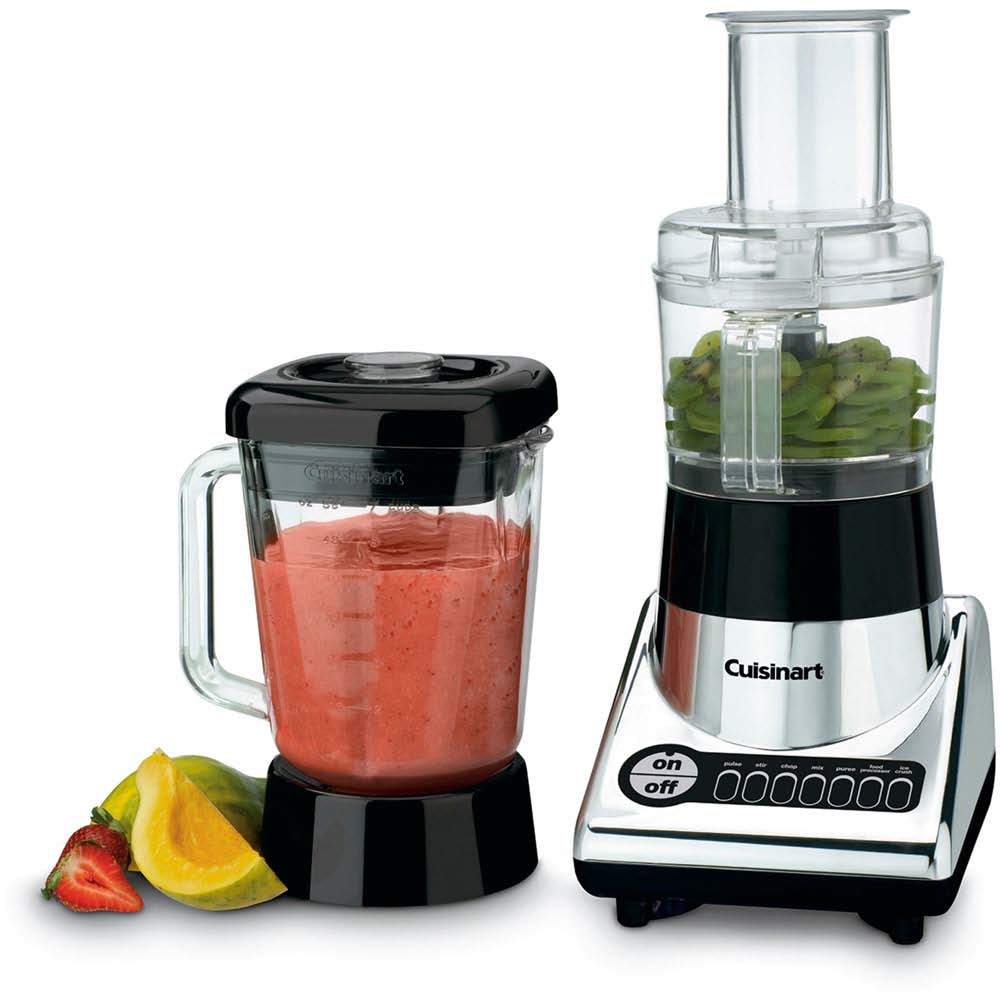
The exact Cuisinart page and product-specific sheet identify model BFP-10CH in Chrome, with a 56-ounce glass jar and separate three-cup processor setup; it is marked discontinued and out of stock.
Explore this need in the finder →Is the nominal 56-ounce glass jar enough for a 48-ounce floor, or is at least 64 ounces essential?
The jar nominally meets a 48-ounce minimum, but it is smaller than a 64-ounce requirement; neither value is a safe finished-fill guarantee.
Explore this need in the finder →Do you need a separate three-cup processor setup with feed tube and reversible slicing/shredding disc for small prep?
The exact BFP-10CH page and Cuisinart product sheet list a separate three-cup bowl, feed tube and pusher, chopping blade and reversible disc. It is a small processor configuration, not extra jar volume.
Explore this need in the finder →Do you want the seven-speed manual touchpad and pulsed Ice Crush in the blender-jar setup rather than an automatic drink program?
The BFP-10CH is a seven-speed LED touchpad package with a separate Pulse and Ice Crush control; Ice Crush runs in short pulses in the blender jar. No timed recipe program is documented.
Explore this need in the finder →The Cuisinart PowerBlend Duet BFP-10CH is an earlier chrome blender/food-processor combination. Cuisinart lists one 56-ounce glass blender jar and a separate three-cup processor attachment for the same base. Those are two setups, not a single vessel with 56 ounces plus three cups of extra blending room. This package is most interesting if both a larger-than-personal pitcher and occasional small food prep matter to you; it is less compelling if you only need one of those jobs.
Two vessels with different jobs
For smoothies, sauces and other jar tasks, the BFP-10CH uses its nominal 56-ounce glass pitcher, lid and measured two-ounce center cap. That is larger than the 40-ounce jar listed for the earlier SmartPower Duet BFP-703, but it remains below a strict 64-ounce family-size minimum. The label capacity also is not a safe finished-fill promise: the manufacturer does not provide a maximum hot-liquid line or exact working batch volume. If 64 ounces is an essential minimum, do not round 56 up or assume the food-processor bowl makes up the difference.
For chopping or slicing, remove the jar arrangement and set up the separate three-cup work bowl with its collar, cover, feed tube, pusher, chopping blade or reversible slicing/shredding disc. The bowl is useful for smaller jobs such as herbs, crumbs, a modest amount of chopped vegetables or a small batch of dip. The booklet describes food prep in short bursts or batches; it also warns against using the processor to mash potatoes, knead dough or beat egg whites. A three-cup attachment is not a substitute for a full-size processor when you routinely prepare large batches.
Manual buttons, not hands-off cycles
Cuisinart describes a seven-speed touchpad with LED indicators and lists Off, On, Pulse, Stir, Chop, Mix and Purée on its exact page. The BFP-10 Series booklet also describes separate Food Processor and Ice Crush controls. These are task-selected manual controls, not an automatic smoothie program. The blender’s Pulse button leaves the length of each burst to you. Ice Crush also works in short pulses, and the booklet says the blender jar can crush ice without liquid. That instruction belongs to the blender-jar setup only: the manual specifically warns that crushing ice in the processor attachment can damage its blade and bowl.
The listed 600 watts is a manufacturer specification, not a measurement of finished texture or a reason to expect a particular result with every frozen recipe. If you prefer named automatic recipes, the earlier PowerEdge CBT-700 has a different setup with named Smoothie and Ice Crush cycles, but it does not include this three-cup processor bowl. If simple manual speed choices matter more than automation, compare those controls with your own routine rather than treating wattage as a performance ranking.
Glass and cleanup require attention
The glass jar is a reason to choose this model if you specifically prefer glass, but it is also a heavier, breakable vessel to lift and store than a small travel cup. The instructions say not to use a chipped or cracked jar. They also say not to add boiling liquid to the glass jar and to let boiling ingredients cool for five minutes first. The nominal 56-ounce label is not permission to blend a full pitcher of hot soup; no numeric hot-fill limit is documented.
Cuisinart’s product page broadly says removable parts are dishwasher-safe, while the booklet gives more useful part-by-part directions. It says the jar can go upside down in the dishwasher and the lid and measured cap on the upper rack, but the blender cutting assembly and gasket should be hand-washed. On the processor side, the bowl, cover, pusher, chopping blade and reversible disc are listed as top-rack safe; the gearbox collar is wipe-only and must not be immersed. The motor base should be wiped with a damp cloth, never submerged. There are more pieces to assemble, wash and store than with a pitcher-only blender, and the sharp processor blade and disc need careful handling.
Who should consider the BFP-10CH?
It suits a household that wants a 56-ounce glass jar, manually selected speed controls, dedicated pulsed ice crushing in the jar and a separate small processor attachment on one base. It is a poor match if you need a confirmed hot-fill volume, a 64-ounce jar, a large food-processor bowl, a hands-off cycle, or a simple single-vessel cleanup routine. The product is discontinued and marked out of stock by Cuisinart; that does not establish the condition, completeness or warranty status of a used example.
When checking a secondhand BFP-10CH, compare the model marking on the base with the exact package rather than buying by the PowerBlend Duet family name alone. Confirm that the glass jar, lid and measured cap, blender blade assembly and gasket, three-cup bowl and collar, processor cover and pusher, chopping blade, reversible disc and disc stem are all present and undamaged. This is a more useful check than assuming that a visually similar SmartPower or Duet package includes the same attachments.
Sources: Cuisinart’s BFP-10CH product page and its model-specific PowerBlend Duet product information sheet. For operating and care details, see the Cuisinart BFP-10 Series booklet in this third-party manual transcript; check the booklet that accompanies any used unit.
Key details at a glance
| Manufacturer-listed container capacity | 56 oz |
|---|---|
| Included container style | One nominal 56-ounce glass blender jar with cover and measured 2-ounce pour lid; the separate three-cup processor bowl is not extra pitcher capacity. |
| Documented variable-speed settings | 7 |
| Speed and Pulse controls | The exact product page calls the LED touchpad seven-speed and identifies Off, On, Pulse, Stir, Chop, Mix and Purée; the booklet separately describes Food Processor and pulsed Ice Crush controls. These are manually selected controls, not timed recipe programs. |
| Named programs/control modes | 0 |
| Published machine warranty term | 3 years |
| Warranty scope and wording | Exact U.S. product page and model-specific sheet list a limited three-year warranty; original terms do not establish remaining eligibility or transferability for a used unit. |
| Footprint and height note | No exact dimensions or assembled clearance were verified in the inspected product page, sheet or manual. |
| Cleaning and heat guidance | The manual says the glass jar may go upside down in a dishwasher and the lid/measured cap on the upper rack; the blender cutting assembly and gasket are hand-washed. Processor bowl, cover, pusher, chopping blade and disc are top-rack dishwasher-safe. Gearbox collar and motor base are wipe-only; do not immerse the collar or base. |
| Included jar material | Glass |
| Included jar / additional blending setup | The glass blender jar and separate three-cup processor work bowl are alternative setups on one base, not additive capacities. |
| Manufacturer-stated motor rating | 600 W |
| Timed cycle details | No automatic recipe cycle is documented in the exact Cuisinart page or inspected BFP-10 Series booklet. |
| Manufacturer listing status when checked | The exact U.S. Cuisinart page displayed Discontinued and Out Of Stock on 2026-10-24; that is not a statement about secondhand availability or condition. |
| Personal blending jars in package | 0 |
| Power-rating basis | The exact Cuisinart page and model-specific product sheet list a 600-watt motor; this is a manufacturer specification, not an independent performance measurement. |
| Power source | False |
| Included personal blending cups | 0 |
| Food processor bowl included | Yes |
| Blending blade dishwasher-safe | No |
| MAX fill guidance | The exact product page and inspected BFP-10 Series booklet do not state a numeric safe finished-fill or hot-liquid maximum; nominal jar capacity is not a usable batch guarantee. |
| Manufacturer model / SKU | BFP-10CH |
| Food-chopper bowl capacity | 3 cups |
| Reversible processor slicing/shredding disc included | True |
Use the exact model’s instructions for operating limits, supplied equipment and version differences.
Sources for this assessment
Choose around the way you blend.
Start with format and batch, then check manual controls, named programs, exact jar package, clearance and cleanup. In the Propel 510/750 family, a second jar is a separate setup—not extra capacity in one blend—and the Classic Bundle has a distinct hand-wash jar. In the nutribullet Ultra family, the standard NB50500IN has no processor, NB20550ID adds a separate two-cup processor, and only NB50550AKID includes the coffee/spice grinder. In nutribullet portable choices, the NBPB50100 keeps its base attached, Flex separates its base and blade, and Flip uses an insulated steel cup with a 16-ounce MAX line. Flex x McLaren’s exact page conflicts on 20 versus 22 ounces; that unknown should not meet a capacity requirement. The nutribullet Personal Blender NB50150-02 is the 700W refresh with a 21-ounce handled tumbler and a separate 24-ounce cup; use its 55-second plan and exact compatibility note rather than assuming old 600W parts fit. The current nutribullet Pro+ N12-1001MK pairs a separate 24-ounce and 32-ounce cup with a one-minute Blend cycle and manual Pulse; nominal cup labels do not replace the marked MAX line. The exact nutribullet Power Core XL Matte White NBF70100AW-02 lists a 72-ounce pitcher, 64-ounce maximum-liquid line and a maker-suggested minimum 16-ounce batch; its guide supports hot ingredients only in the vented pitcher and expressly says not to crush ice. The nutribullet Lite NBI50200 is a two-speed immersion set with a 30-ounce cup label but a 350 ml manual MAX mark; direct hot-pot blending does not specify a maximum pot or hot volume. The current McLaren Pro NB9-0901MC lists separate 32- and 24-ounce cups but showed out of stock; the discontinued Matte Eucalyptus SKU lists two separate 32-ounce cups. Oster MyBlend Plus SAP 2126144 is one cold-only sport-bottle setup; Easy-to-Clean SAP 2181510 keeps its glass pitcher and separate 20-ounce cup in different plans, and unknown cup instructions stay unknown. Oster MyBlend Plus SAP 2126144 is one cold-only sport-bottle setup; Easy-to-Clean SAP 2181510 keeps its glass pitcher and separate 20-ounce cup in different plans, and unknown cup instructions stay unknown. The Hamilton Beach Smoothie Blender 50181FG/FJ, 50182FG/FJ and 50183F/FJ family has one 48-ounce BPA-free jar, while its directly linked guide names 50180 rather than those exact codes; check the supplied manual before planning a hot batch.